



Cost Tape In Hair Extensions is one of the first things many shoppers want to understand before choosing this extension method.
But there is no single number that applies to everyone.
The total cost usually comes from four different parts: the extension hair itself, professional installation, ongoing maintenance, and eventually replacing some or all of the hair.
For a simple starting point, customers can use the following figures as general reference prices only. Actual prices may be lower or higher depending on hair length, amount of hair, color, salon location, stylist, and maintenance needs.
Based on GUGU Hair’s September 2026 pricing information and current consumer-market references, a practical product-only budget for approximately 100g of tape-in human hair can be around $120 to $320 for common 18–24 inch options.
This is a reference range rather than a fixed GUGU Hair retail price. Longer lengths, lighter blonde shades, ombré colors, dimensional highlights, and larger quantities may increase the final product cost.
Understanding each part of the total cost can help you compare Tape In Hair Extensions more realistically and decide whether they fit both your styling goals and your budget.
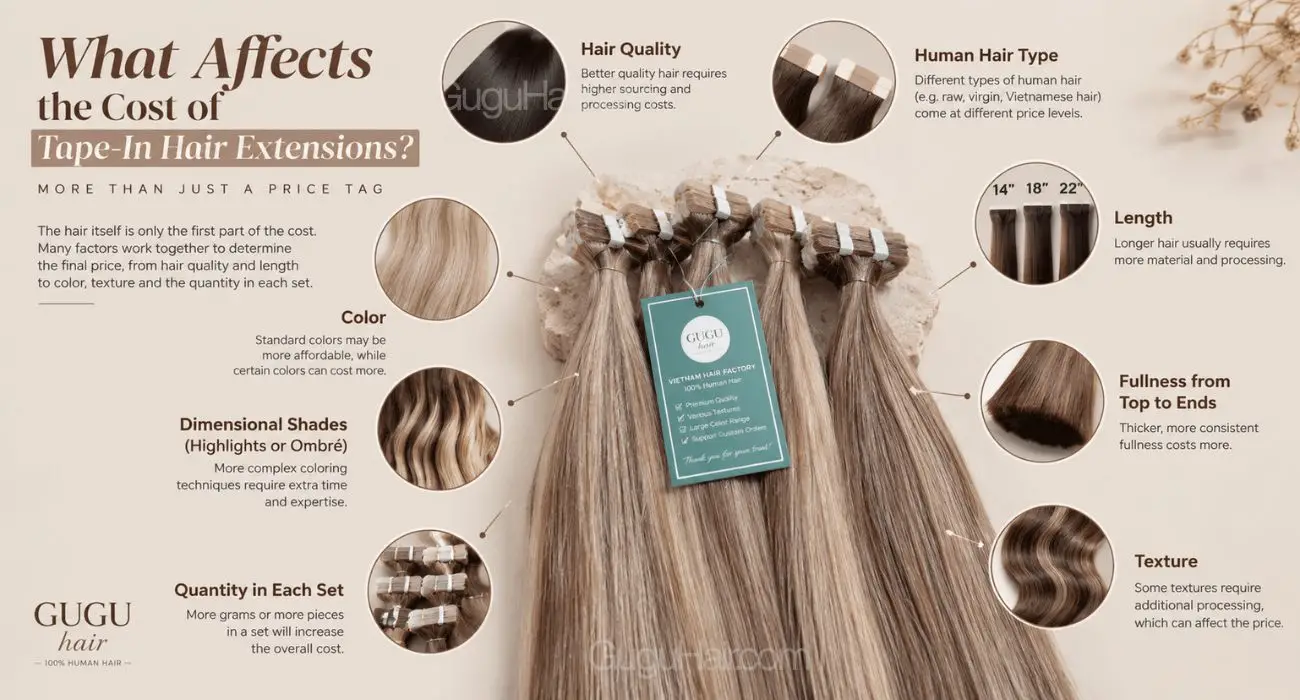
The product price is usually the first number customers notice, but it is only the starting point.
Two sets of tape-in extensions may look similar in a photo while being very different in hair quality, length, fullness, texture, color, and construction. Those differences can influence both the product price and the way the extensions perform after installation.
Some of the main factors that affect product cost include:
As a retail reference only, the following table can help shoppers understand how the product budget may change with length. The figures are standardized around approximately 100g of tape-in hair for easier comparison and are not fixed selling prices.
| Length | Approximate Product Cost | What May Push the Price Higher |
|---|---|---|
| 18 Inches | About $120–$220 / 100g | Blonde, ombré, dimensional color, higher hair grade |
| 20 Inches | About $130–$250 / 100g | Blonde, highlighted color, higher hair grade |
| 22 Inches | About $150–$280 / 100g | More processed colors, higher hair grade, additional hair |
| 24 Inches | About $180–$320 / 100g | Longer length, blonde or ombré color, additional volume |
Important: These figures are provided as a budgeting reference for customers. They are not a final quotation and do not include installation, maintenance, shipping, taxes, or additional hair that may be needed for the desired result.
Longer hair usually costs more because the underlying hair cost increases with length. Color can also make a noticeable difference, especially when comparing natural darker shades with blonde, highlighted, ombré, or mixed colors.
For customers comparing products online, it is useful to look beyond the number on the price tag.
Ask yourself: What exactly am I getting for this price?
Check the length, weight, amount of hair, hair material, texture, and color before assuming that two products are directly comparable, which is different with wholesale player:
>>See more: Tape-in hair extensions wholesale: What Salons and Hair Businesses Should Check Before Ordering

Many first-time buyers think mainly about length.
They see 18-inch, 20-inch, or 24-inch tape-ins and choose based on how long they want the finished hairstyle to be.
But length is only one part of the equation. The amount of volume you want also influences how much extension hair you may need.
Someone who already has relatively full hair and only wants additional length may need less extension hair than someone who wants both a noticeable increase in length and a much fuller hairstyle.
This matters because the product cost generally increases as both length and the amount of hair increase.
For example, the reference prices above are calculated around approximately 100g. If your desired hairstyle requires more hair, the total product budget may be higher even if you choose the same length and color.
Before choosing your tape-ins, think about the result you want:
The answer affects not only the number of extensions needed but also the overall investment. A customer who needs less hair for subtle fullness may spend less than someone who needs more hair to create a dramatic transformation. This is why discussing the desired result with a professional stylist before purchasing the hair can be useful. Instead of automatically choosing the longest or fullest option, choose the amount of hair that supports the result you actually want.
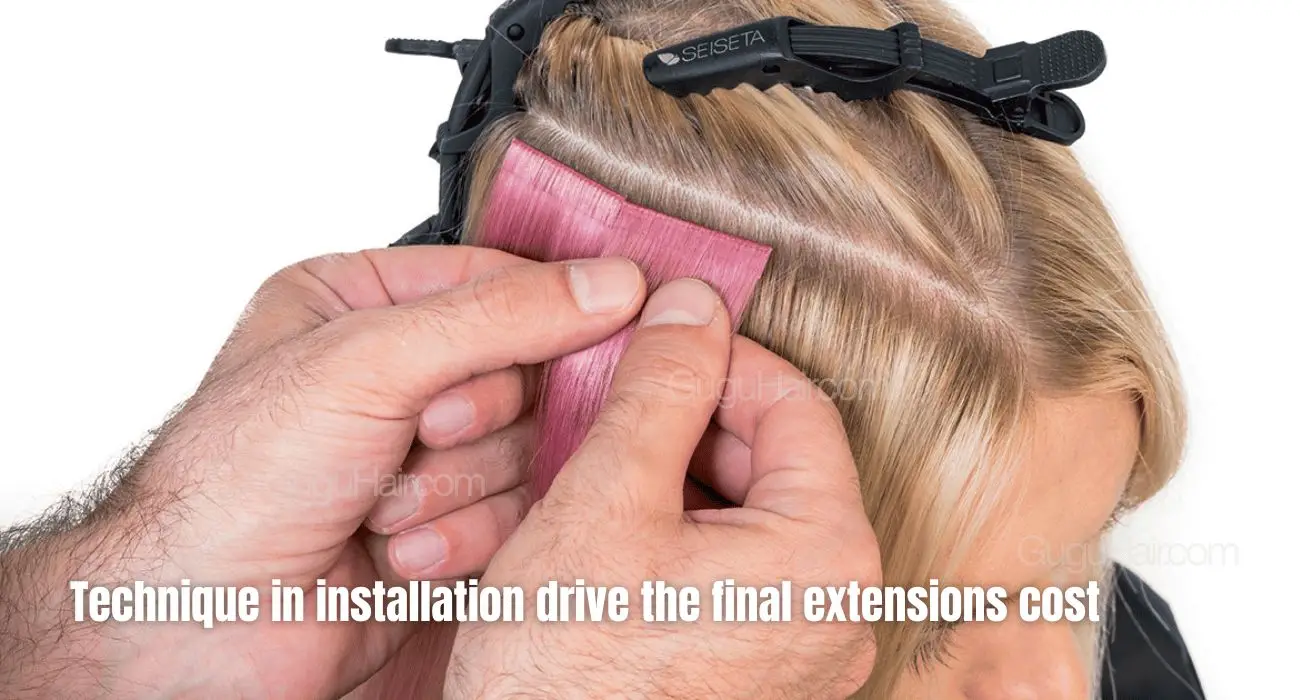
Tape-in extensions are not simply a product that you purchase and wear immediately.
They normally involve professional installation.
In many cases, the extension hair and the salon installation fee are charged separately.
Installation pricing may vary depending on:
As a general reference, professional tape-in installation may cost around $75 to $200 in many cases, although higher-priced salons or more complex installations can cost more.
This means two customers can buy the same tape-in hair but still pay different total amounts.
A fuller installation usually requires more time, more sections, and potentially more cutting or styling afterward.
This is why it can be misleading to compare tape-ins only by the product price.
A more realistic equation is:
Product cost + installation cost = initial investment
Using the reference ranges in this guide, a customer buying approximately 100g of tape-in hair might spend around $120–$320 on the product plus approximately $75–$200 on installation.
That creates an illustrative first-appointment budget of around $195–$520.
This is only a reference example. Your actual total may be lower or higher depending on how much hair is required, the chosen length and color, and your stylist’s pricing.
If you are budgeting for tape-ins for the first time, ask your stylist what is included in the installation service.
Some salons may include trimming or blending, while others may charge separately for additional styling.
Knowing this in advance can help you avoid unexpected costs. Explore GUGU Hair current Tape-in Extensions here!
Tape-in extensions require maintenance because your natural hair continues to grow.
As the hair grows, the tape attachment gradually moves farther away from the scalp. At some point, the extensions may need to be removed, repositioned, and reapplied.
That means the cost of wearing tape-ins does not end after the first appointment.
Depending on your routine and stylist, ongoing costs may include:
As a general reference, a tape-in move-up or maintenance appointment may cost approximately $50 to $150 per visit. Some salons charge according to the amount of hair, number of rows, or time required, so the actual price can vary.
Maintenance frequency also depends on natural hair growth, installation, lifestyle, and how the extensions are cared for.
For this reason, it is useful to think of tape-ins as a recurring beauty expense rather than only a one-time purchase.
For example, if your maintenance appointment costs around $50–$150, two maintenance visits would add approximately $100–$300 to your total cost of wearing the extensions.
Again, this is a reference calculation only. Different clients may require different maintenance schedules.
This does not automatically mean tape-in extensions are expensive.
It simply means you should understand the ongoing upkeep before choosing the method.
If you prefer a hairstyle with very little follow-up maintenance, tape-ins may require more planning than you expect.
If you are comfortable scheduling maintenance appointments and caring for the hair properly, the method may fit your routine well.
Even well-maintained extensions do not remain new forever.
Over time, you may need to replace some or all of the hair depending on wear, styling habits, maintenance, and the condition of the extensions.
Replacement can become part of the long-term cost in several situations.
You may want or need to replace the hair because:
This is why comparing only the initial price can create unrealistic expectations.
A better question is:
How long will this hair remain suitable for the way I want to wear it?
The answer depends on the product, care routine, styling habits, and frequency of use.
There is no single lifespan that applies to every wearer because maintenance and daily habits can vary significantly from person to person.
If only a small number of pieces need to be replaced, the cost may be much lower than purchasing an entirely new set. If most of the extension hair needs replacing, your replacement budget may eventually become similar to your original product cost.
Using the product figures in this guide as a reference, replacing approximately 100g of hair could mean budgeting another $120–$320, depending on length, color, hair type, and the price available at the time of replacement.
This figure is only a reference and should not be interpreted as a guaranteed replacement price.
A more useful approach is to focus on proper care, realistic expectations, and the condition of the hair over time.
A lower-priced product may look attractive when you are comparing options, but price alone does not tell you whether the product offers good long-term value.
If the hair becomes dry quickly, tangles easily, loses fullness, or becomes difficult to style, a lower upfront price may not necessarily save money over time.
When evaluating human hair tape in extensions prices, pay attention to factors such as:
The useful comparison is not simply which product has the lowest number on the price tag.
Instead, compare products with similar length, amount of hair, color, texture, and construction so that the prices actually represent similar products.
This becomes especially important if you plan to wear tape-in extensions regularly rather than only for a temporary hairstyle.
Not every customer wants a basic straight black or brown set.
Some customers may be looking for:
These options may require additional processing, color work, or production time.
As a result, the final product price may differ from standard natural shades or straight textures.
This difference is already reflected in the reference product ranges above. Natural or darker shades may sit closer to the lower end of the range, while blonde, ombré, highlighted, or more complex colors may sit closer to the upper end.
If you are shopping for a specific look, compare products with similar specifications rather than comparing only the lowest-priced listing.
For example, a natural black straight tape-in set should not necessarily be compared directly with a dimensional blonde highlighted set.
They may involve different production requirements and create very different styling results.
Instead of searching for one universal price, build your budget around the full experience of wearing tape-in extensions.
Think about four main categories:
How much does the extension hair itself cost?
For approximately 100g of 18–24 inch human hair tape-ins, a useful retail reference range for this guide is around $120–$320.
Check the length, amount of hair, color, texture, and product specifications. Longer lengths and more processed colors may fall toward the upper end of the reference range.
How much will your stylist charge to apply and blend the extensions?
A useful installation reference is approximately $75–$200, although salon pricing can vary substantially.
Ask whether cutting, blending, or final styling is included.
Will you need regular removal, repositioning, or reapplication appointments?
A useful maintenance reference is approximately $50–$150 per appointment.
Also consider extension-friendly hair care products and tools that may become part of your routine.
Will you need to replace some or all of the extension hair later?
If a full replacement is needed, the future hair cost may be similar to purchasing the product again. Using this article’s current reference range, that could mean approximately $120–$320 for around 100g, depending on the specifications and future price.
A partial replacement may cost less because you may not need to replace every piece.
When you consider all four categories together, the real cost of tape-in extensions becomes much easier to understand.
| Cost Category | Reference Amount |
|---|---|
| Product – Approx. 100g | $120–$320 |
| Initial Installation | $75–$200 |
| Maintenance / Move-Up | $50–$150 per visit |
| Full Hair Replacement – Approx. 100g | About $120–$320 at the current reference level |
Example: If your tape-in hair costs about $180 and your installation is $120, your initial cost would be approximately $300. If you later have two $80 maintenance appointments, your running total would become approximately $460, before any eventual replacement.
This example is provided only to illustrate how the four cost categories work together. It is not a fixed price or quotation.
Explore the GUGU Hair Tape-in current product for your estimation here!
It is completely reasonable to have a budget.
However, choosing extensions based only on the lowest visible product price can sometimes make it harder to estimate the real long-term cost.
A lower-cost set may become less economical if:
Instead of asking:
“What is the cheapest tape-in extension?”
try asking:
“What will I realistically spend on the hair, installation, maintenance, and eventual replacement?”
That question gives you a much clearer picture of the real budget.
So, how much do tape-in hair extensions cost?
The answer depends on more than the product price alone.
As a simple reference, approximately 100g of 18–24 inch human hair tape-ins may fall around $120–$320 for the hair itself, while professional installation may add around $75–$200.
Maintenance may then add approximately $50–$150 per appointment, and replacement becomes another future expense if some or all of the extension hair eventually needs to be changed.
That means your total tape-in budget should always be considered as:
Product cost + installation + maintenance + replacement
These numbers are intended as reference ranges only. The actual amount you spend can vary according to length, color, amount of hair, stylist, salon location, maintenance schedule, and how long your extensions remain suitable for use.
The most useful approach is to plan for the full cost of wearing tape-ins rather than focusing only on the initial product price.
Explore GUGU Hair Tape-In Hair Extensions to compare available lengths, colors, textures, and product options.
You can also follow GUGU Hair on Instagram for real product content, or contact the GUGU Hair team if you need help choosing an option that fits your styling goals and budget.




TOP 1 GUGU HAIR
FACTORY VIETNAM